
Introduction
Cancer remains one of the most complex and devastating diseases of our time. Despite advances in surgery, chemotherapy, immunotherapy, and precision medicine, predicting how a tumor will behave in a specific patient remains a major challenge. Two patients with the same diagnosis can respond very differently to the same treatment.
Enter the digital twin: a virtual replica of a patient’s tumor and body, built from imaging, genomic, and clinical data. In oncology, digital twins offer the possibility of simulating cancer progression and testing therapies in silico — before applying them in real life. This approach could transform cancer care from reactive to predictive, enabling doctors to choose the right treatment at the right time for each individual.
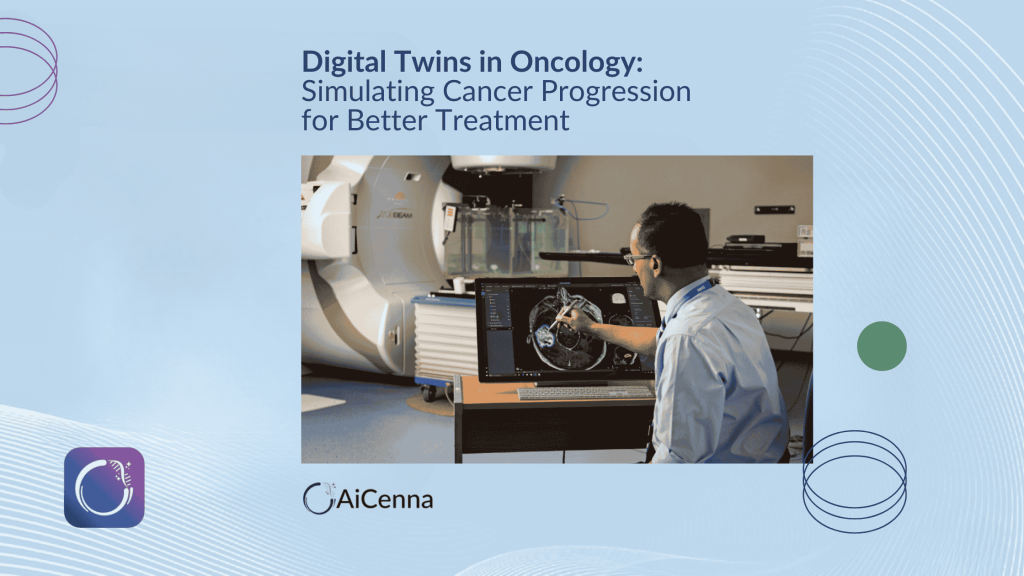
What Is a Digital Twin in Oncology?
A digital twin in oncology is a computational model that mirrors the biology of a patient’s cancer. It integrates:
- Genomic data: Mutations, gene expression, and epigenetic changes.
- Imaging data: MRI, CT, PET scans showing tumor size, shape, and spread.
- Histopathology: Microscopic features of tumor tissue.
- Clinical data: Patient demographics, comorbidities, treatment history.
- Biomarkers: Circulating tumor DNA, immune signatures, metabolic markers.
The twin is continuously updated as new data are collected, making it a “living model” of the patient’s cancer.
(Reference: Björnsson et al., Nat Rev Clin Oncol, 2020 — “Digital twins in oncology.”)
Why Oncology Needs Digital Twins
Cancer is not a single disease but hundreds of distinct conditions with unique molecular drivers. Traditional clinical trials provide population‑level evidence, but they cannot capture the full variability of individual patients.
- Heterogeneity: Tumors evolve over time, developing resistance to therapy.
- Trial limitations: Most patients do not fit neatly into trial populations.
- Toxicity: Many treatments have severe side effects; predicting benefit vs. harm is critical.
Digital twins address these challenges by allowing personalized simulations of disease progression and treatment response.
Applications of Digital Twins in Cancer Care
1. Predicting Tumor Growth and Progression
- Models simulate how a tumor will grow under different conditions.
- Can forecast when metastasis is likely to occur. (Reference: Altrock et al., Nat Rev Cancer, 2015 — mathematical modeling of tumor evolution.)
2. Optimizing Treatment Selection
- Virtual trials can test chemotherapy, targeted therapy, or immunotherapy on the twin before applying them to the patient.
- Helps avoid ineffective treatments and unnecessary toxicity.
3. Monitoring Resistance
- Twins can model how tumors develop resistance to drugs.
- Enables proactive switching to alternative therapies.
4. Surgical and Radiation Planning
- Imaging‑based twins simulate how much tissue to remove or how radiation will affect surrounding organs.
5. Clinical Trials and Drug Development
- In silico trials using digital twins can reduce reliance on animal models.
- Accelerates drug development by predicting which patients are most likely to benefit.
Case Studies and Emerging Evidence
- Breast Cancer: Researchers have developed digital twins that simulate tumor response to neoadjuvant chemotherapy, improving prediction of pathological complete response【Björnsson et al., 2020】.
- Glioblastoma: Computational models integrating MRI and molecular data predict tumor recurrence and guide personalized radiotherapy【Rockne et al., Cancer Res, 2019】.
- Immunotherapy: Digital twins are being used to model immune‑tumor interactions, helping identify which patients will respond to checkpoint inhibitors【Tang et al., Nat Commun, 2021】.
Benefits for Patients and Clinicians
- Personalization: Tailors therapy to the individual, not the average patient.
- Safety: Reduces trial‑and‑error in treatment selection.
- Efficiency: Saves time and resources by focusing on likely effective options.
- Empowerment: Patients can visualize their disease and understand treatment choices.
Challenges and Limitations
1. Data Integration
- Requires harmonizing genomic, imaging, and clinical data from multiple sources.
2. Validation
- Models must be validated against real‑world outcomes before clinical adoption.
3. Computational Demands
- High‑fidelity simulations require significant computing power.
4. Ethical and Privacy Concerns
- Digital twins contain highly sensitive genomic and health data.
- Questions remain about ownership, consent, and secondary use.
5. Equity
- Access to advanced sequencing and imaging is limited in many regions.
- Risk of widening disparities if digital twins are only available in wealthy healthcare systems.
(Reference: Nature Medicine, 2021 — “Ethical challenges of digital twins in healthcare.”)
The Future of Digital Twins in Oncology
- Integration with AI: Machine learning will refine predictions and detect subtle patterns in tumor evolution.
- Multi‑omics twins: Incorporating proteomics, metabolomics, and microbiome data for deeper insights.
- Population‑scale twins: Aggregated models could inform public health strategies and drug development.
- Real‑time updates: Wearable biosensors and liquid biopsies will allow continuous updating of twins.
(Reference: Corral‑Acero et al., Eur Heart J, 2020 — digital twin frameworks in medicine.)
Conclusion
Digital twins in oncology represent a paradigm shift in cancer care. By simulating tumor progression and treatment response, they offer the potential to move from reactive treatment to proactive, predictive, and personalized medicine.
While challenges remain in data integration, validation, and equity, the trajectory is clear: digital twins could become a cornerstone of oncology, helping doctors choose the right therapy at the right time — and ultimately improving survival and quality of life for millions of patients.