Introduction
Mental health disorders are among the leading causes of disability worldwide, affecting more than 970 million people according to the World Health Organization (WHO). Depression, anxiety, bipolar disorder, and schizophrenia not only reduce quality of life but also increase risk of chronic physical illness and premature death.
Despite the scale of the problem, diagnosis and treatment remain challenging. Mental health care has historically relied on subjective assessments — patient self‑reports and clinician observations. Unlike cardiology or oncology, psychiatry has lacked objective biomarkers or predictive models.
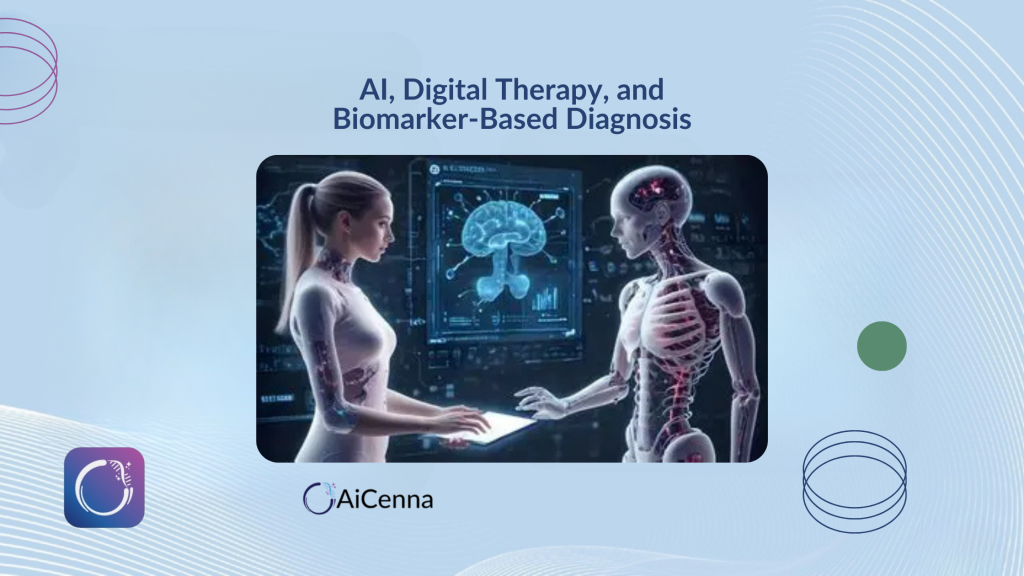
That is beginning to change. Advances in artificial intelligence (AI), digital therapeutics, and biomarker research are reshaping how mental health is understood, diagnosed, and treated. This article explores the evidence, opportunities, and challenges of this transformation.
The Current State of Mental Health Diagnosis
- Subjectivity: Diagnosis is based on criteria from manuals like DSM‑5 or ICD‑11, which rely on reported symptoms.
- Heterogeneity: Two patients with the same diagnosis may have very different underlying biology.
- Trial‑and‑error treatment: Antidepressants, antipsychotics, and mood stabilizers often require multiple attempts before finding an effective regimen.
(Reference: Insel, T. “The digital revolution in mental health.” World Psychiatry, 2018.)
Artificial Intelligence in Mental Health
1. Predictive Analytics
- AI models analyze electronic health records, social media data, and wearable metrics to predict risk of depression, suicide, or relapse.
- Example: Machine learning algorithms have achieved >80% accuracy in predicting suicide attempts within 2 years in high‑risk populations. (Reference: Walsh et al., JAMA Psychiatry, 2017.)
2. Natural Language Processing (NLP)
- AI can detect subtle changes in speech, tone, and word choice that correlate with depression or psychosis.
- Pilot studies show NLP can identify early signs of schizophrenia before clinical diagnosis.
3. Personalized Treatment
- AI systems recommend therapies based on patient profiles, improving outcomes and reducing trial‑and‑error prescribing.
Digital Therapy: Mental Health in Your Pocket
1. Cognitive Behavioral Therapy (CBT) Apps
- Digital CBT platforms (e.g., Woebot, MoodGYM) deliver structured therapy via smartphones.
- Randomized controlled trials show digital CBT can be as effective as face‑to‑face therapy for mild to moderate depression. (Reference: Andrews et al., PLoS One, 2018.)
2. Virtual Reality (VR) Therapy
- VR exposure therapy helps treat phobias, PTSD, and social anxiety by simulating controlled environments.
- Studies show VR therapy is as effective as traditional exposure therapy, with higher patient engagement.
3. Telepsychiatry
- Video consultations expand access, especially in underserved areas.
- During COVID‑19, telepsychiatry use increased by over 1,000%, demonstrating scalability.
4. Gamified Interventions
- Digital games designed to improve attention, memory, and mood are being tested as adjunctive therapies.
- The FDA approved the first prescription video game (EndeavorRx) for ADHD in 2020.
Biomarker‑Based Diagnosis: Toward Objective Psychiatry
1. Neuroimaging
- fMRI and PET scans reveal brain activity patterns linked to depression, schizophrenia, and PTSD.
- AI enhances interpretation, identifying biomarkers invisible to human observers.
2. Blood‑Based Biomarkers
- Inflammatory markers (e.g., CRP, IL‑6) are elevated in subsets of depressed patients.
- Neurotrophic factors like BDNF correlate with resilience and treatment response.
3. Digital Biomarkers
- Data from smartphones and wearables — sleep, activity, voice, typing speed — can serve as proxies for mental state.
- Continuous monitoring provides early warning of relapse.
(References: Dantzer et al., Nat Rev Immunol, 2008; Insel, Nat Biotechnol, 2017.)
Benefits of the New Paradigm
- Early detection: Identifying risk before symptoms become severe.
- Precision psychiatry: Matching treatments to biological and behavioral profiles.
- Accessibility: Digital tools expand reach to underserved populations.
- Continuous monitoring: Moving from episodic care to ongoing support.
Challenges and Limitations
1. Data Privacy
- Mental health data is highly sensitive. Strong safeguards are essential.
2. Validation
- Many AI and biomarker studies are promising but small‑scale. Large, diverse trials are needed.
3. Equity
- Access to digital tools and advanced diagnostics may be limited in low‑resource settings.
4. Human Connection
- Technology cannot replace the therapeutic alliance between patient and clinician.
(Reference: Hollis et al., Lancet Psychiatry, 2019.)
The Future of Mental Health Care
- Integrated platforms: Combining genomics, biomarkers, and digital monitoring into unified care systems.
- AI‑assisted clinicians: Augmenting, not replacing, human judgment.
- Preventive psychiatry: Identifying at‑risk individuals before illness manifests.
- Global scalability: Leveraging mobile technology to reach billions worldwide.
(Reference: Nature Medicine, 2021 — “Precision psychiatry: the next frontier.”)
Conclusion
Mental health care is on the cusp of a transformation. By combining AI, digital therapy, and biomarker‑based diagnosis, psychiatry can move from subjective assessments and trial‑and‑error treatments to objective, personalized, and preventive care.
The challenge is to ensure these innovations are validated, ethical, and accessible. If achieved, the future of mental health may finally match the precision and progress seen in other fields of medicine — offering hope to millions who have long waited for better answers.