Introduction
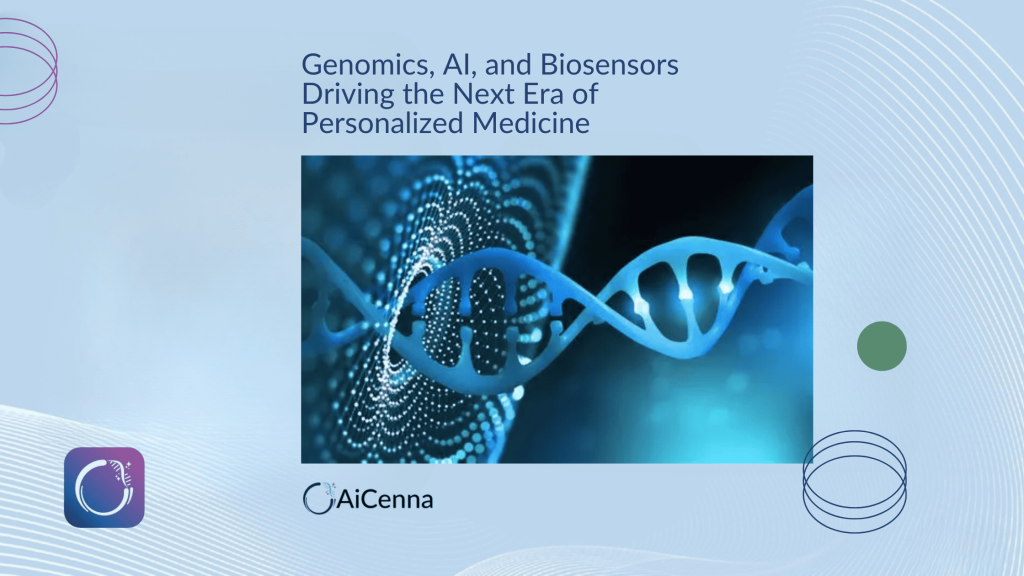
For much of modern history, medicine has been practiced as a “one‑size‑fits‑all” discipline. Patients with the same diagnosis often receive the same treatment, even though outcomes vary widely. Today, advances in genomics, artificial intelligence (AI), and biosensors are converging to change that paradigm. The goal is personalized medicine — tailoring prevention, diagnosis, and treatment to the unique biology of each individual.
This article explores how these three fields are intersecting, the evidence behind their promise, and the challenges that must be addressed before personalized medicine becomes the global standard of care.
Genomics: Reading the Blueprint of Health
The sequencing of the human genome in 2003 was a landmark achievement. Since then, costs have plummeted from nearly $3 billion to under $500 for a full genome.
Applications in personalized medicine:
- Risk prediction: Identifying genetic variants linked to diseases such as breast cancer (BRCA1/2) or cardiovascular disease.
- Pharmacogenomics: Using genetic data to guide drug choice and dosage (e.g., CYP2C19 variants affecting response to clopidogrel).
- Rare disease diagnosis: Whole‑exome sequencing has solved thousands of previously undiagnosed cases.
(References: Collins et al., Nature, 2003; Manolio et al., NEJM, 2019.)
Biosensors: Real‑Time Health Monitoring
Biosensors are devices that detect biological signals and convert them into measurable data. Unlike traditional lab tests, they provide continuous, real‑time monitoring.
Examples:
- Continuous glucose monitors (CGMs): Transforming diabetes management.
- Wearable ECG patches: Detecting arrhythmias outside the clinic.
- Sweat sensors: Measuring electrolytes and hydration.
- Next‑generation sensors: Under development for cortisol, lactate, and even cancer biomarkers.
By integrating biosensor data with genomics, doctors can see not only a patient’s predisposition to disease but also their real‑time physiology.
(Reference: Nature Biomedical Engineering, 2020 — review on wearable biosensors.)
Artificial Intelligence: Making Sense of Complexity
Genomic sequencing produces terabytes of data. Biosensors generate continuous streams of information. AI is the tool that makes this data clinically useful.
Roles of AI in personalized medicine:
- Pattern recognition: Detecting subtle correlations between genes, biomarkers, and outcomes.
- Predictive modeling: Forecasting disease risk or treatment response.
- Decision support: Assisting clinicians in choosing the right therapy for the right patient.
- Drug discovery: Identifying new therapeutic targets based on genetic and molecular data.
(Reference: Topol, E. “High‑performance medicine,” Nat Med, 2019.)
Case Studies
1. Oncology
- Tumor sequencing identifies mutations that guide targeted therapies (e.g., EGFR inhibitors in lung cancer).
- AI analyzes imaging and genomic data to predict which patients will respond to immunotherapy.
2. Cardiology
- Polygenic risk scores combined with biosensor data can predict heart attack risk years before symptoms.
- AI‑driven digital twins simulate how an individual’s heart will respond to interventions.
3. Endocrinology
- CGMs paired with AI algorithms provide personalized insulin dosing recommendations.
- Genomic data helps identify patients at risk for type 2 diabetes.
(References: NEJM, 2018 — precision oncology; Corral‑Acero et al., Eur Heart J, 2020 — digital twins in cardiology.)
Benefits of Integration
- Proactive prevention: Identifying risks before disease develops.
- Precision treatment: Matching therapies to genetic and physiological profiles.
- Reduced side effects: Avoiding drugs unlikely to work or likely to cause harm.
- Empowered patients: Real‑time feedback encourages healthier behaviors.
Challenges and Limitations
1. Data Privacy and Security
- Genomic and biosensor data are highly sensitive.
- Strong safeguards are needed to prevent misuse.
2. Equity and Access
- Sequencing and biosensors remain expensive in many regions.
- Risk of widening health disparities if access is unequal.
3. Clinical Validation
- Many AI models work in research but fail in real‑world clinics.
- Rigorous trials are needed to prove benefit.
4. Ethical Concerns
- How should incidental genetic findings be handled?
- Who owns the data — patients, providers, or companies?
(Reference: Nature Medicine, 2021 — “Ethics of personalized medicine.”)
The Future of Personalized Medicine
- Multi‑omics integration: Combining genomics with proteomics, metabolomics, and microbiome data.
- AI‑driven clinical trials: Using digital twins to simulate outcomes before enrolling patients.
- Preventive focus: Shifting from treating disease to maintaining wellness.
- Global adoption: Ensuring that personalized medicine benefits not just wealthy nations but all populations.
(Reference: National Academies of Sciences, Engineering, and Medicine, 2022 — “Realizing the Promise of Personalized Medicine.”)
Conclusion
Personalized medicine is no longer a distant vision. By combining genomics, AI, and biosensors, healthcare is moving toward a future where prevention is proactive, treatment is precise, and patients are empowered partners in their care.
The challenge now is not whether personalized medicine is possible — it is how to make it equitable, ethical, and accessible. If achieved, this convergence could mark one of the greatest transformations in the history of medicine.