
Introduction
Heart disease remains the leading cause of death worldwide, responsible for nearly 18 million deaths annually according to the World Health Organization (WHO). Despite advances in treatment, many patients are diagnosed only after symptoms appear — often when damage is already irreversible.
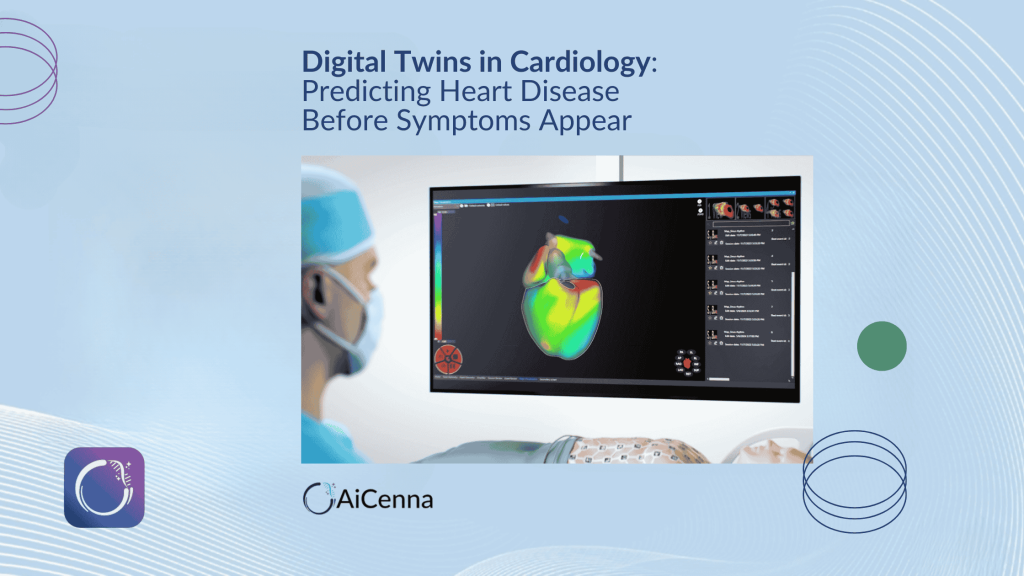
Enter the concept of the digital twin: a virtual replica of a patient’s heart, built from imaging, biosensor data, and genetic information. This technology allows doctors to simulate how an individual’s heart functions, predict disease progression, and test interventions before they are applied in real life. What was once science fiction is now becoming a powerful tool in preventive cardiology.
What Is a Digital Twin?
A digital twin is a dynamic, data‑driven model of a physical system. In healthcare, it represents a patient’s organ or even their entire physiology. For cardiology, this means creating a personalized, virtual heart that mirrors the patient’s anatomy and function.
Key inputs include:
- Medical imaging: MRI, CT, and echocardiography provide structural detail.
- Electrophysiology data: ECGs and wearable monitors capture electrical activity.
- Hemodynamic data: Blood pressure, flow rates, and oxygenation.
- Genomic and biomarker data: Genetic predispositions and molecular signatures.
(Reference: Viceconti et al., “In silico trials: A roadmap for the future of medical simulation,” Front Physiol, 2016.)
Why Cardiology Is a Natural Fit
The heart is a highly dynamic organ where small changes can have major consequences. Digital twins are particularly suited to cardiology because:
- Complexity: The interplay of electrical, mechanical, and fluid dynamics is ideal for computational modeling.
- Data availability: Cardiology already relies heavily on imaging and monitoring.
- High disease burden: Cardiovascular disease is the top global killer, making prevention critical.
Applications in Predicting Heart Disease
1. Early Detection of Arrhythmias
- Digital twins can simulate electrical conduction pathways.
- By integrating ECG data, they can predict susceptibility to atrial fibrillation or ventricular tachycardia before symptoms occur. (Reference: Trayanova et al., Nat Rev Cardiol, 2021.)
2. Personalized Risk Stratification
- Traditional risk scores (like Framingham) are population‑based.
- Digital twins allow individualized predictions, incorporating genetics, lifestyle, and physiology.
3. Virtual Stress Testing
- Instead of waiting for symptoms, doctors can simulate how a patient’s heart responds to exercise or stress.
- This can reveal hidden ischemia or early heart failure.
4. Optimizing Treatment
- Before implanting a pacemaker or defibrillator, clinicians can test device placement virtually.
- Drug responses can be modeled to predict efficacy and side effects.
5. Monitoring Progression
- Twins can be updated continuously with wearable data, showing how disease evolves in real time.
Case Studies and Clinical Evidence
- Johns Hopkins University: Researchers used digital heart models to predict arrhythmia risk in patients with cardiomyopathy, improving accuracy over standard methods【Trayanova et al., Nat Rev Cardiol, 2021】.
- European Union’s “SimCardioTest” project: Developing in silico trials for cardiac drugs and devices, reducing reliance on animal testing【EU Horizon 2020, 2022】.
- Philips & Siemens Healthineers: Industry leaders are piloting digital twin platforms for cardiology imaging and intervention planning.
Benefits for Patients and Clinicians
- Proactive care: Identifying disease before symptoms.
- Personalization: Tailoring interventions to the individual, not averages.
- Safety: Testing therapies virtually reduces risk.
- Efficiency: Potentially lowers costs by avoiding unnecessary procedures.
Challenges and Limitations
- Data Quality and Integration
- Incomplete or biased data can reduce accuracy.
- Integrating imaging, genomics, and wearables remains technically complex.
- Validation
- Models must be rigorously validated against clinical outcomes.
- Regulatory frameworks for in silico medicine are still evolving.
- Equity
- Access to advanced imaging and genomics is limited in low‑resource settings.
- Risk of widening health disparities if digital twins are only available to wealthy patients.
- Privacy and Ethics
- Digital twins contain highly sensitive health data.
- Questions remain about ownership, consent, and secondary use.
(Reference: Nature Medicine, 2021 — “Digital twins in healthcare: ethical and regulatory challenges.”)
The Future of Digital Twins in Cardiology
- Integration with AI: Machine learning will refine predictions and detect subtle patterns.
- Population‑scale twins: Aggregated models could inform public health strategies.
- Real‑time monitoring: Continuous updates from biosensors may allow “living” twins that evolve with the patient.
- Preventive cardiology: Routine use of digital twins could shift care from reactive treatment to proactive prevention.
(Reference: Corral‑Acero et al., Eur Heart J, 2020 — “The digital twin in cardiology.”)
Conclusion
Digital twins represent a paradigm shift in cardiology. By creating virtual replicas of patients’ hearts, doctors can predict disease before symptoms appear, personalize treatment, and monitor progression in real time. While challenges remain in data integration, validation, and equity, the potential is transformative.
For the first time, medicine may move from treating heart disease after it strikes to preventing it before it begins.